
Code obfuscation and linguistics
The parallels between linguistic obfuscation and code obfuscation

Introduction
This blogpost explores the meaning of linguistic obfuscation, and how it is connected to linguistic theory. It then goes to show how obfuscation is used in cybersecurity, and how we can look at types of code obfuscation through the linguistic lens.

What seems to puzzle Frodo? Obfuscation. We’ll take a look at what obfuscation means in the context of linguistics, and how that maps onto some practices in cybersecurity.
Linguistic obfuscation
Linguistic obfuscation means making communication deliberately unclear, confusing or unintelligible, trying to hide the true intentions of the participant or misrepresent them. It’s when we use language itself to hide the actual meaning and intention behind our statements.
Today, this can often be seen in the use of vague and imprecise language and formulations – especially in the corporate environment, but also in politics, throughout history and in international relations.
“We have achieved significant progress on the issue.”
“We have optimized effluent management strategies for enhanced workflow interface.”
Linguistic obfuscation this way undermines transparency of communication: it is a tactic, or a sophisticated communication strategy, also related to power dynamics. Obfuscation can construct or reinforce particular (fabricated) aspects of reality while obscuring others, which don’t fit the speaker’s narrative.
It can also be used to seemingly avoid responsibility, or mask inaction or incompetence, which can be achieved by replacing direct language with less direct formulations, or by employing the passive voice. Linguistic obfuscation can be achieved through the use of euphemisms to soften negative impacts or implications. One of the more infamous ones is the example of the Russian invasion of Ukraine, and the subsequent war, which has been repeatedly labelled as a “special military operation”.
Obfuscation can also be achieved by making the language overly technical, rendering the output inaccessible to certain parts of the audience – overwhelming them with jargon, technical nuance and minutiae. By employing such specialized, less comprehensible terms, the speaker or writer attempts to divert the attention from the actual substance of the communicated piece of information.
Part of this is also the result of using vague quantifiers and modifiers, which dilutes the directness of the arguments, allowing for possible loopholes and circumventions. Using words such as “significant” or “substantial”, and the confusion in their use and understanding, may easily lead to the readers’ misinterpretation of what is being said1.
And lastly, maybe also most recently, such vague language and formulations are also often generated by LLMs and generative AI, where stochastic models generate tokens strictly based on statistical distribution within their training sets. While these models’ responses are using tokens that are in the given context most likely to occur, and are the most represented in their training set, they are inadvertently employing obfuscation: as they completely lack semantic understanding of both the training set and the resulting token chains they are generating – effectively masking their lack of understanding behind sophisticated-sounding token chains.
Linguistic obfuscation is all around us – so how is it connected to linguistic theory?
Obfuscation and linguistic theory
Obfuscation can be also framed within linguistic theory: specifically, through the lens of Grice’s linguistic maxims, or, more precisely, through the flouting thereof.

As Antoine Decressac (Linguistically Yours!) points out in his blogpost, “Grice’s theory focuses on the distinction between what is said and what is meant.” And that’s exactly the gap that obfuscation creates: the difference between what is said and what is actually meant.
As mentioned in the blogpost, Grice developed four maxims, which guide how we communicate:
Maxim of Quantity: Give the right amount of information, not too much or too little.
Maxim of Quality: Be truthful, don’t say something you believe to be false or lack evidence for
Maxim of Relation: Be relevant, stick to the topic at hand.
Maxim of Manner: Be clear, avoid ambiguity or unnecessary complexity.
And, as pointed out in the same blogpost, this is what flouting of the Grice’s maxims could look like (direct citation):
Flouting the Maxims
Of Quantity
A: “Where are you staying?”
B: “In a hotel.”
Here, B flouts the Maxim of Quantity by not giving information to A. B may be indicating they do not want A to come over. A must infer the meaning from this minimal answer.
Of Quality
Two friends are walking through a park, and one points to a small, scruffy dog.
A: “What a majestic creature!”
B: (laughs)
Here A’ s statement is clearly false: the small, scruffy dog is anything but majestic. By flouting the Maxim of Quantity (truthfulness) the speaker creates humour or exaggerates for comedic effect.
The listener recognises that the speaker isn’t intending to be truthful and infers the humorous or ironic intent. Flouting the maxim in this way often strengthens social bonds, as both parties share in the humour or absurdity. However, if the listener doesn’t realise the speaker is being ironic or playful, it could lead to misunderstanding or confusion.
Of Relation
Deliberately violating a maxim can still create meaning. For instance:
A: “How was the food?”
B: “The plate was lovely.”
Here, B flouts the Maxim of Relation (relevance). By commenting on the plate instead of the food, B implies that the food wasn’t good, without explicitly saying so. Listeners infer meaning based on shared assumptions about how conversations usually work.
Of Manner
A teacher is explaining how to solve a simple maths problem to a student
Student: ”How do I solve this equation?”
Teacher: “Well, to approach it, you must first conceptualise the numerical values as abstract entities within a theoretical framework, then manipulate them according to algebraic principles to achieve equilibrium.”
The teacher deliberately uses an overly complex and convoluted explanation for something that could be stated more clearly (e.g., “Rearrange the equation to find x”). This flouts the Maxim of Manner by being unnecessarily obscure and verbose.
This can create frustration or confusion. The listener may struggle to extract the intended meaning from the overly complex or unclear response. The flouting might imply something beyond the surface meaning, for instance, the teacher could be making a joke about overcomplicating things or subtly criticising the question.
Effective communication depends on clarity. By flouting this maxim, the speaker forces the listener to interpret their words with extra effort, potentially damaging understanding.
©Antoine Decressac — 2024/2025.
Linguistic obfuscation operates precisely on the basis of breaking (flouting) the rules (maxims) – sometimes one of them, sometimes more of them. Code obfuscation basically operates in the same way, only the breaking of these rules is manifested differently.
So where does the relation between linguistic obfuscation and code obfuscation lie?
Code obfuscation
Obfuscation reduces the readability and understandability of code – often by making it seemingly more complex – in the attempt to hide the code’s logic and purpose, while still keeping it fully operational and executable. This can slow down automated analysis, as well as human attempts at decompiling or analyzing the code, buying the attackers more time for their malicious activities. Unlike encryption, which makes data unreadable without a key, obfuscation makes the code hard to decipher yet operational without decryption.
Code obfuscation therefore operates based on the same principles as linguistic obfuscation: hiding the intended meaning behind convoluted structure or expressions.
Code obfuscation and linguistics
Adversaries in the cyberspace use code obfuscation to hide malicious functionality of their code by obfuscating execution flows, variables, messages or specific notes, therefore complicating automated analysis as well as the malware analysts’ jobs. Given that pieces of code are still, in some sense, linguistic units: they have form and meaning, and are tied to specific actions, we can apply Grice’s principles, which allows us to look at code obfuscation through the linguistic lens.
If we consider code as a language of itself, intended to convey instructions from human to machine, we could speak of communication. On top of that, the code compiled by adversaries in cyberspace is often the only means of communication between the attackers and the defenders (found in snippets in malware), becoming the main language of somewhat involuntary, or unintended, communication. If we assume that we could consider code to be, in some contexts and situations, a form of language; therefore, code compiling and code analysis (or reverse engineering) would constitute two ends of a communication channel, we could apply, on such a channel, the theory of Grice’s linguistic maxims – more precisely, in the case of obfuscation, flouting of these maxims.
Author’s note: The following list of obfuscation techniques is not exhaustive, and it includes only selected methods, which can be explained through the lens of Grice’s linguistic maxims.
Code obfuscation methods
There are various ways how obfuscation can be introduced into the code, and each instance maps on to flouting one (or more) of Grice’s linguistic maxims.
Variable Renaming and Method and Function Renaming
Variable renaming and method/function renaming are key techniques in code obfuscation to make the code less readable and harder to reverse-engineer. Variable renaming involves changing the names of variables to meaningless or obscure identifiers. For example, a variable originally named userCount might be renamed to a1 or x5. This makes the code’s functionality difficult to understand.
Before
public class LicenseValidator {
private bool CheckExpiration(DateTime expiryDate) {
return DateTime.Now < expiryDate;
}
}
After
public class a {
private bool b(DateTime c) {
return DateTime.Now < c;
}
}
In this example, variable names have been simply swapped for different symbols, which are not descriptive of the variables’ functions. This kind of obfuscation renders the logic of the code harder to follow for analysts, but it does not affect the functionality or execution of the code itself.
Linguistic perspective
From a linguistic perspective, variable and function renaming in code obfuscation can be understood as a violation of Grice’s maxims, especially the maxims of manner and quantity. Descriptive identifiers such as LicenseValidator, CheckExpiration, expiryDate satisfy these maxims by being orderly, unambiguous and as informative as required. Renaming them to opaque symbols like a, b or c breaks this cooperative principle.
String Encryption
String encryption is a critical component of code obfuscation that protects sensitive data and textual information within the source code. Developers encrypt strings, rendering them unreadable to unauthorized individuals who access the code. These encrypted strings within the code are then decrypted at runtime.
Before
string apiUrl = “https://api.example.com/v2/payments”;
string apiKey = “sk_live_abc123”;
After
string apiUrl = Decrypt(new byte[] { 0x4A, 0x7B, 0x2C, ... });
string apiKey = Decrypt(new byte[] { 0x8F, 0x1D, 0xA3, ... });
Linguistic perspective
String encryption in code obfuscation can be framed as flouting of Grice’s maxims of manner and quantity. Plaintext strings (e.g., URLs or API keys) normally function like transparent utterances – clear and unambiguous. Encrypting them disrupts this clarity, replacing intelligible “utterances” with deliberately opaque forms. The semantic content remains intact, but it becomes inaccessible without the correct decryption “context”. As a result, the code preserves its functional meaning for authorized interpreters at runtime, while pragmatically excluding unintended readers and resisting interpretation, much like language that is intentionally encrypted to conceal meaning.
Encoding Techniques
Encoding techniques in code obfuscation involve transforming the original code into a different format using algorithms that make it less readable while maintaining its functionality. These techniques include base64 encoding, URL encoding, and hexadecimal encoding, which convert readable strings and code segments into encoded formats that are more challenging to interpret. Unlike encryption, encoding is not intended to secure data but to obscure it, making reverse engineering more difficult. By using encoding techniques, developers can protect sensitive information and application logic from being easily understood.
Linguistic perspective
From a linguistic perspective, encoding techniques in code obfuscation can be interpreted through both Grice’s cooperative principle and Saussure’s semantic triangle. In Gricean terms, encoding disrupts the maxims of manner and quantity by replacing clear, directly interpretable strings with transformed representations such as Base64 or hexadecimal, thereby reducing transparency. At the same time, Saussure’s model highlights how encoding alters the relationship between the signifier and the signified: the underlying concept remains unchanged, but its surface form is systematically remapped into a less accessible signal. This weakens the immediate link between representation and meaning for unintended readers while preserving it for those who can decode it. As a result, the code maintains semantic integrity at the functional level, yet strategically degrades interpretability, using form as a barrier without modifying meaning.
Control Flow Obfuscation
Control flow obfuscation is a sophisticated technique used to disguise the logical structure of a program, making it exceedingly difficult for an attacker to understand and reverse-engineer the code. This method involves altering the control flow of the application by adding misleading or redundant code, reordering instructions, and creating convoluted branching paths. The primary goal of control flow obfuscation is to obfuscate the true execution path of the program, thereby protecting critical logic and algorithms from being easily deciphered.
Before: clear algorithm
if (user.isActive && user.balance > amount) {
processPayment(amount);
sendReceipt(user.email);
}
After: flattened control flow (conceptual)
int state = 0;
while (true) {
switch (state) {
case 0: state = (x3 > 0) ? 4 : 7; break;
case 4: state = (x1 ^ x2) != 0 ? 2 : 7; break;
case 2: f0(x5); state = 5; break;
case 5: f1(x6); state = 7; break;
case 7: return;
}
}
Linguistic perspective
Control flow obfuscation can be seen as an intentional and systematic violation of Grice’s maxims, especially the maxim of manner. A clear control structure – such as a straightforward conditional – adheres to expectations of orderliness, brevity and transparency, enabling readers to infer the program’s “narrative” with minimal effort. Obfuscation disrupts this cooperative clarity by introducing redundant states, convoluted branching and non-linear execution paths, transforming a coherent discourse into a fragmented and misleading one. While the underlying “propositional content” of the code remains unchanged, its pragmatic accessibility collapses, as the surface form no longer guides interpretation.
Dead Code Insertion
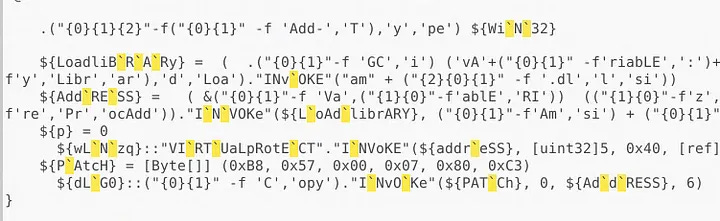
Dead code insertion involves adding code that does not affect the program’s functionality or output. This extraneous code, often composed of no-op operations or irrelevant calculations, is strategically placed within the original code to confuse anyone attempting to reverse-engineer the application. By increasing the volume of code without altering its behavior, dead code insertion makes it significantly harder for an attacker to discern the actual logic and flow of the program. This technique effectively increases the complexity and analysis time, thereby enhancing the security of the software. This includes fake method calls, unreachable branches, and decoy calculations.
Example (extraneous code highlighted)
Linguistic perspective
This obfuscation method flouts Grice’s linguistic maxim of quantity: provide the right amount of information. Dead code is redundant; it adds sections that never execute or aren’t essential to the outcome. It is as if someone asked about the time, and your answer would be: It is 3 p.m., and my shoes are blue, and I once visited Prague. For the recipient, it becomes harder to distinguish the substance from noise.
Code obfuscation in practice
Let’s say you have a simple code, the purpose of which is to add two numbers (a and b) together, and return the result. The code could look something like this:
function addNumbers(a, b) {return a + b;}
This code is easy to read and understand, even for someone who has never had anything to do with coding (or with the help of a very brief explanation).
However, if you obfuscate this code, it might look something like this:
function _0x3f5c(_0x1a2d9c,_0x3d512a) {return _0x1a2d9c+_0x3d512a;}
Notice that the variables retain the same properties, i.e. they remain constant (a is always 0x1a2d9c, and b is always 0x3d512a). However, at first glance, it’s much more difficult to parse this code snippet compared to the “clean” one (unobfuscated) above; and it may come across, at first glance, simply as gibberish.
So, on the linguistic plain, we could speak of flouting some of Grice’s linguistic maxims, even in such a highly technical field as coding and cybersecurity.
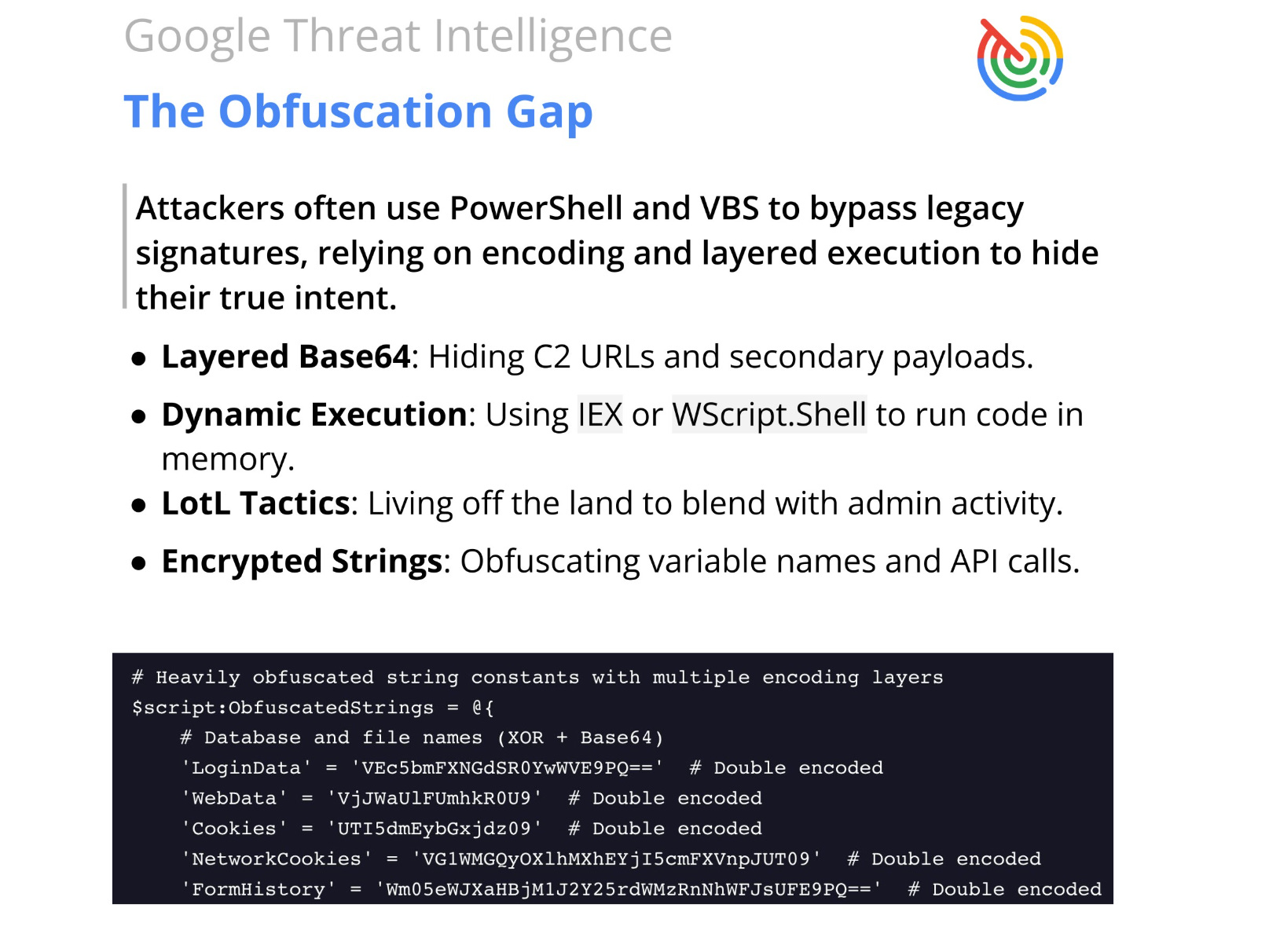
Another option, perhaps a more sophisticated or complicated one, is combining two or more methods above. As also discussed and exemplified in a simple exercise in Encoding and linguistics, we can layer encoding techniques.

But if we take this a step further, we can also layer encoding techniques in combination with encryption, as demonstrated by Google Threat Intelligence where XOR encryption was used in combination with base64 encoding (strings were first XOR encrypted and then the resulting strings were base64 encoded).
Conclusion
Linguistic obfuscation and code obfuscation operate on the same principle: preservation of meaning while deliberately obstructing interpretation. In linguistics, this manifests as vague formulations, excessive complexity or strategic ambiguity that widen the gap between what is said and what is meant. In code, the same effect is achieved through structural and representational transformations that retain functionality while concealing intent.
Linguistic lens highlights that code is a form of communication, and obfuscation intentionally flouts cooperative principles. By violating Grice’s maxims – clarity, relevance, truthfulness and sufficient information – both natural language and code can be shaped to mislead, obscure or selectively reveal meaning. This parallel provides a useful conceptual framework for understanding how different obfuscation methods work, helps frame adversarial techniques in wider context, reinforces the importance of applying a multidisciplinary approach, and demonstrates relevance of linguistics in highly technical fields such as coding and cybersecurity.
Sources:
https://promon.io/resources/knowledge-center/code-obfuscation-guide
https://digital.ai/catalyst-blog/guide-how-to-obfuscate-code/
https://promon.io/resources/security-software-glossary/code-obfuscation
https://docs.bytehide.com/guides/understanding-code-obfuscation
https://khireddinekhirou123.medium.com/javascript-obfuscation-and-deobfuscation-18dfdfd0faac
https://medium.com/@goddardl307/malicious-powershell-de-obfuscation-0ef8ce7daf21
In this particular case, something “substantial” may or may not be significant; but readers often consider these terms as synonyms, i.e. they would consider something described as “substantial” almost automatically as something that is “significant”. These modifiers are also not exactly measurable, enabling the speaker or writer to make claims without commitment to specific facts, statistics or figures, allowing for a much higher possibility of misinterpretation or misunderstanding – therefore, we can consider this in some contexts as linguistic obfuscation.